
Place
Hyrkoon
Region in the further east of Essos, on the eastern side of the Bone Mountains
The warrior maids of Hyrkoon, who wear iron rings in their nipples and rubies in their cheeks
Hyrkoon is a region in the further east of Essos, on the eastern side of the Bone Mountains. It is located east of the Dothraki Sea, west of the Plains of the Jogos Nhai, and northwest of Yi Ti.
City-states such as Bayasabhad and Samyrian are located in Hyrkoon.
The region is famous for its fierce warrior-women, who are known for their decorative body modifications. The warrior-women of Hyrkoon go about bare-breasted with iron rings through their nipples, and rubies studded into their cheeks.
In the books
In the A Song of Ice and Fire novels, the city-states of Hyrkoon and their warrior-women have been mentioned in passing several times - for instance, Daenerys Targaryen noticed them in the Eastern Market of Vaes Dothrak. Very little, however, has been revealed about their culture and history. A major update came with the publication of The World of Ice & Fire sourcebook in 2014, but even then, Hyrkoon didn't get a full section to itself, so information is still somewhat limited.
History and geography
The formal name of this region is the "Patrimony of Hyrkoon", though this name is something of a misnomer, as the original Patrimony fell many centuries ago: Due to being located in the rain shadow of the Bone Mountains, Hyrkoon has always been highly prone to drought. The years-long seasonal cycles across both Westeros and Essos have gradually trapped a large amount of ocean water as polar ice over the millennia, lowering the sea levels and leading to desertification in many areas. In the case of Hyrkoon, this increasing aridity over the years eventually caused the Patrimony to collapse, but its culture did not vanish completely; three large fortress-cities, originally built to guard the mountain passes along its western borders survived, and in time turned into independent city-states.
From north to south, these city-states are Kayakayanaya, Shamyriana, and Bayasabhad. Located high up in the mountain passes, they survive economically by extracting heavy tolls from the traders and armies that pass through the range. Caravans from Yi Ti travel over the mountains to Vaes Dothrak, Slaver's Bay, Qarth and back. In Vaes Dothrak, the Yi Tish caravans exchange goods with merchants from the Free Cities (particularly Qohor), some of whom are selling secondhand wares all the way from Westeros (such as fine wines).
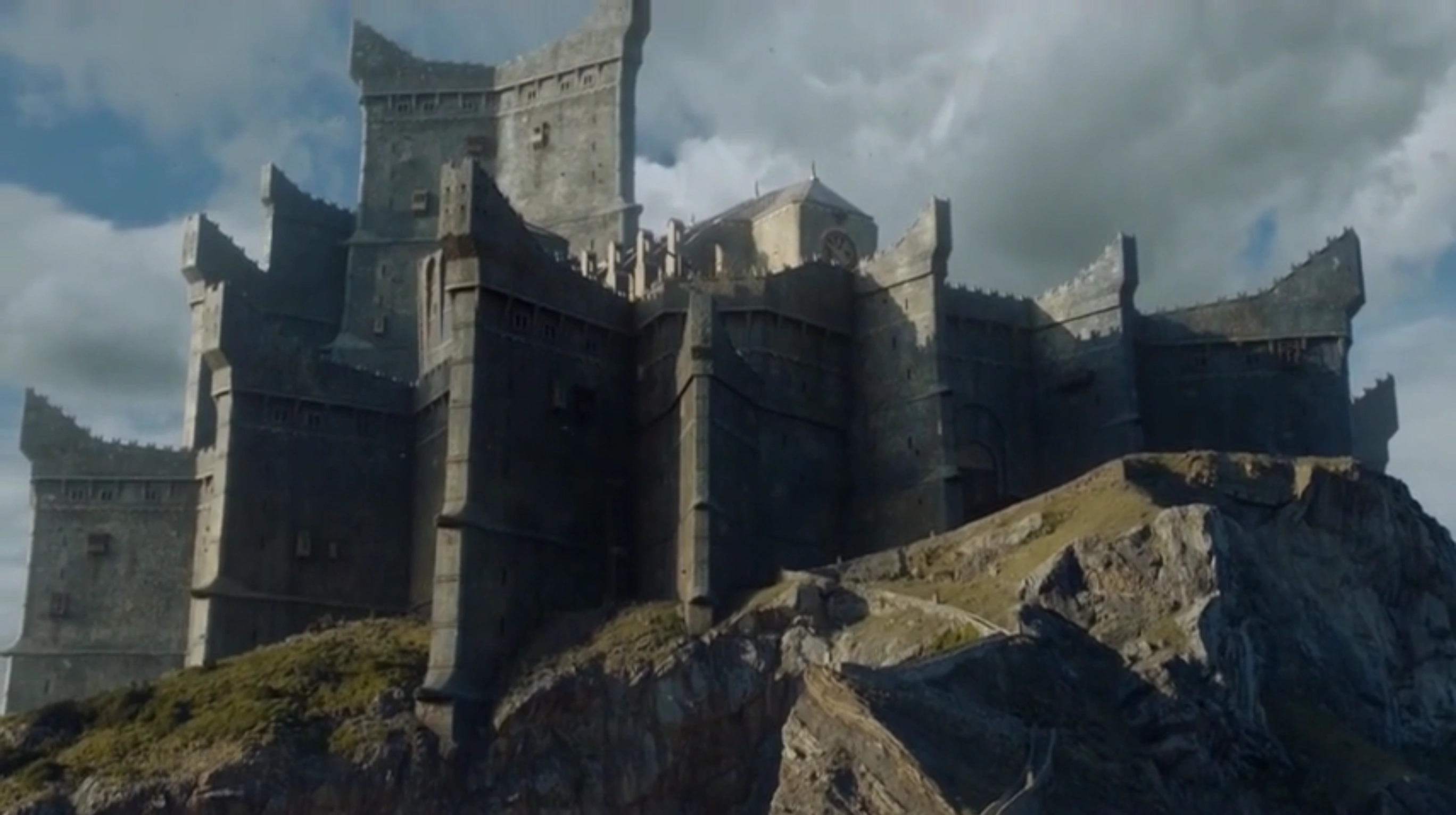
There are only three passes through the Bone Mountains large enough for armies or trade caravans to cross through, each of which is guarded by one of these cities. The northern pass is guarded by Kayakayanaya, a city with walls made of black basalt, black iron, and yellow bone. Known as the Steel Road for all the battles that have taken place upon it, at least a dozen Dothraki khals have led their hordes to destruction at the city's gates, and the Jogos Nhai to the east are perpetually at war with the city, constantly launching both major campaigns and smaller raids beyond count. At such latitudes, the mountains are snow-capped and the weather bitterly cold, so the guards and guides of Kayakayanaya need to wear heavy furs. The Steel Road is also the most physically treacherous of the three, filled with rickety rope bridges and even running through underground passageways at various points, leaving travelers vulnerable to raids from savage tribes living in the mountains and caves.
The Stone Road runs through the middle of the Bones and is controlled by Shamyriana, a grey city carved into the rock of the mountain it defends. Both the Steel Road and the Stone Road originate in Vaes Dothrak, but while the Steel Road runs due east through the mountains, the Stone Road runs south, before curving east to meet the old Silk Road (which runs east out of Slaver's Bay through Lhazar) before passing through the range. The Stone Road itself is filled with deep gorges and treacherous narrow switchbacks, making navigation tricky and hazardous.
In the southern region of the Bones, the Sand Road runs through Bayasabhad, also known as the City of Serpents. The southern Bones are the driest part of the range, and with water scarce, Bayasabhad exacts heavy tribute from overland caravans between Yi Ti and Qarth. Despite this, the Sand Road is arguably the safest of the three passes; it skirts the eastern edge of the Red Waste - thus avoiding a vast, unforgiving desert - to bring trade caravans to Qarth. Because of their disparate latitudes, trade caravans from Kayakayanaya are likely to be heading to Vaes Dothrak, caravans from Shamyriana to Slaver's Bay (though some also to Vaes Dothrak), and caravans from Bayasabhad to Qarth.
Culture
The maesters of Westeros are stated to possess only sketchy reports about the history and culture of the Hyrkoon city-states (an in-universe explanation of why even the World book - written by a maester - only gives a few scraps of information about them).
The first notable thing mentioned about the warrior-women of Hyrkoon was that they wear iron rings in their nipples and ruby studs in their cheeks. Something of a running joke in the book fandom for the next 18 years (between the release of the first novel and the World book) is that this was essentially the only thing revealed about them. The World book explains more details about their culture, beliefs, social organization, etc., but also offers a wry explanation for why so little information was given before; maesters who have written about them at all are so obsessed with the fact that the women go about with their breasts bare that their "treatises" do little more than remind the reader of this fact over and over again.
The social structure of the Hyrkoon city-states is reminiscent of a eusocial species, like bees or mole-rats: Of all the males born in Hyrkoon, 99 out of every 100 are castrated when they reach adulthood. These eunuchs perform all non-martial tasks in society, such as farmers, artisans, healers, scholars, and priests - essentially they serve as worker drones in their society. Only the healthiest and most attractive 1 in 100 young men are not castrated, and go on to become the true ruling class, the so-called "Great Fathers". Only the Great Fathers can sire children with the women of the cities, thus they are literally the fathers of the population. It is apparently for this reason that their empire was formally styled as the "Patrimony" of Hyrkoon.
The women of Hyrkoon, daughters of the Great Fathers, are all warriors, and they form the entire military of their cities. One report received by the maesters indicates that in Hyrkoon religious beliefs, only those who can give life (i.e. through childbirth) are allowed to take life away. In some ways these fierce, terrifying warrior-women are similar to the Amazons of Greek myth - namely the older versions of the myths that describe them as ruthless and bloodthirsty (though the Hyrkoon warrior women don't live entirely without men). The women are taught to ride and climb before they learn to walk, and from earliest childhood they are instructed in the use of the bow, spear, knife, and sling. Lomas Longstrider claimed there are no fiercer fighters in all the known world.
The Hyrkoon city-states have a longstanding and bitter feud with the Jogos Nhai raiders to the northeast, which stretches back millennia. In truth, the Jogos Nhai are perpetually in a state of low-level war against all bordering peoples, though they are more like raiders than all-out conquerors such as the Dothraki. The Dothraki, however, will at least make temporary truce with their neighbors if given tribute - but the Jogos Nhai will not be appeased. They have been warring with the Hyrkoon since long before the fall of their original Patrimony; burning towns, poisoning wells, and carrying off thousands into slavery. For their part, the Hyrkoon warrior-women have a savage hatred for the Jogos Nhai, and have sacrificed tens of thousands of the raiders to their "dark and hungry gods" (the only description given of the Hyrkoon religion). The Hyrkoon seem to have a more peaceful relationship with Yi Ti to their southeast, judging from all the Yi Tish caravans that pass through them. So long as the Dothraki don't try to force the mountain passes to raid the eastern side, the Hyrkoon also seem content to leave them in peace (again, due to the caravans they depend on selling in Dothraki markets to merchants from the Free Cities) - of course, the mountain passes are much easier to defend against Dothraki coming from the west (deterring them from future attacks), while the eastern side of the Bones where the city-states are is more open to endless raids by the Jogos Nhai.
The Patrimony of Hyrkoon is named after the legendary hero who is called "Hyrkoon" in their tales, who wielded a flaming sword named Lightbringer during a war to bring back the dawn which ended the Long Night. Other regions have similar legends though they know the hero by different names: in the Lord of Light religion this legendary figure is known as Azor Ahai.
Sources
Adapted from the original article, under CC BY-SA 3.0.