
Lore
Common Tongue
The Common Tongue, or simply Common, is a language spoken natively throughout…

Do you know the Common Tongue?
The Common Tongue, or simply Common, is a language spoken natively throughout the Seven Kingdoms, and in Essos as a trade language.
History
As the Andals spread across the continent of Westeros they imposed their language upon their conquests, so that the Andals' language gradually replaced the "Old Tongue" spoken by the First Men. Even in the North, where the First Men had held off the Andal invaders, due to cultural contact and emulation the Northerners gradually adopted the language of their Andal neighbors to the south. Thus for thousands of years, there has been one "common" language throughout all of the Seven Kingdoms. The unification of the Seven Kingdoms in Aegon's Conquest three hundred years ago served to strengthen this linguistic uniformity even further.
Range
In the present day, the Common Tongue is ubiquitous throughout the Seven Kingdoms. Even the hill tribes who live in the Mountains of the Moon, who have rarely had regular contact with outsiders for centuries (beyond raiding and pillaging), can still recognizably speak the Common Tongue (with only some slight, unrefined regional variation).
Through trade contact (and raiding), many of the wildlings who live beyond the Wall also know how to speak the Common Tongue. Only those wildlings who live further away from the Wall still speak the Old Tongue of the First Men. Some who live furthest away from the Wall, such as the Thenn people and the giants, don't know how to speak the Common Tongue at all, and exclusively speak the Old Tongue. A few of the main leaders among the Thenn, such as Styr, have also learned how to speak the Common Tongue to communicate with other major tribes.
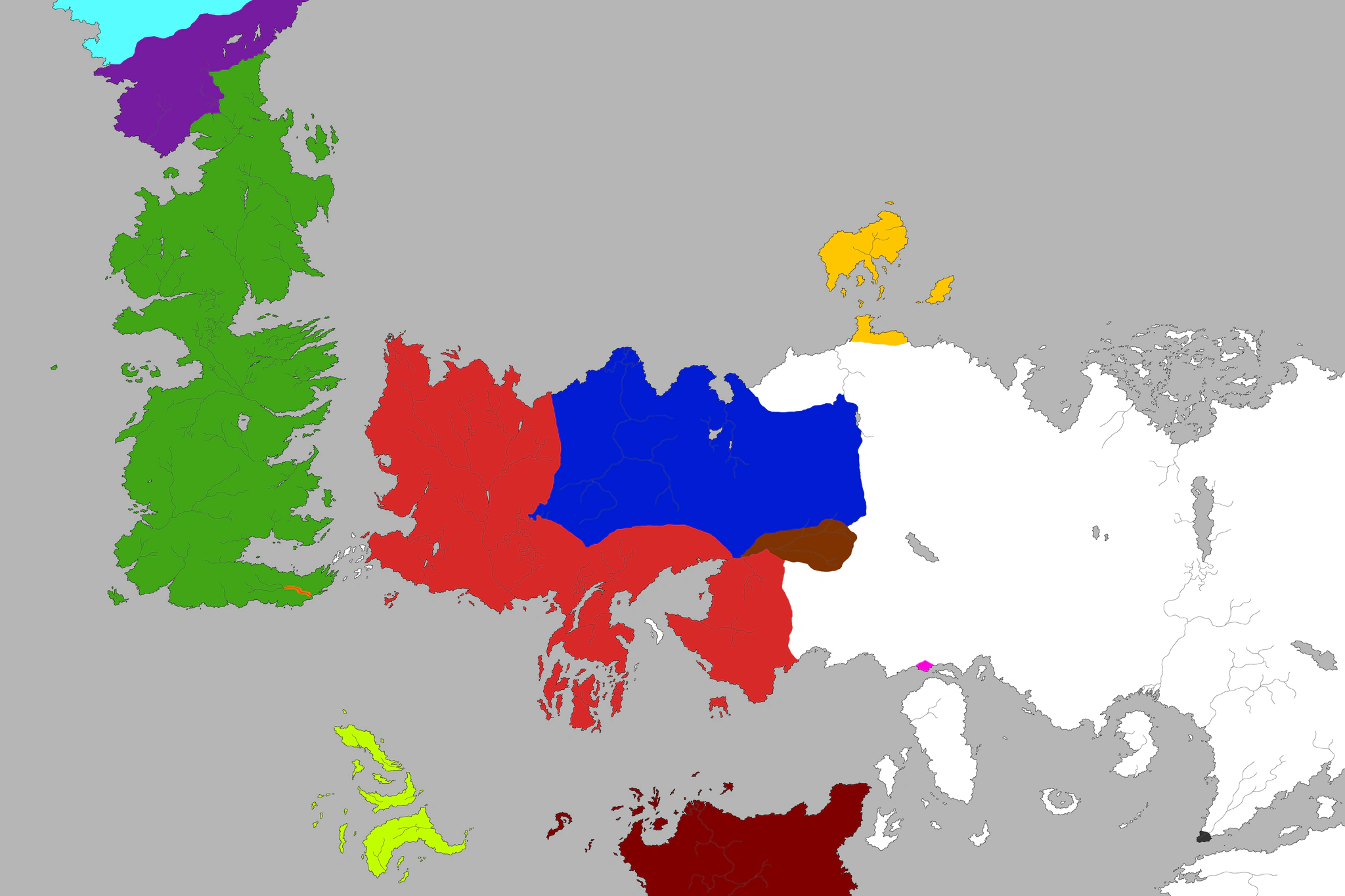
Over the centuries the Common Tongue of Westeros has also spread through much of the rest of the world along trade routes, and thus many people in the Free Cities do know how to speak the Common Tongue, while still primarily using their own local languages. Through trade and shipping, the Common Tongue is even spoken as far east as Qarth. In contrast to the mercantile Free Cities, the Dothraki horse raiders do not engage in trade with Westeros, therefore few of them know the Common Tongue.
Regional accents
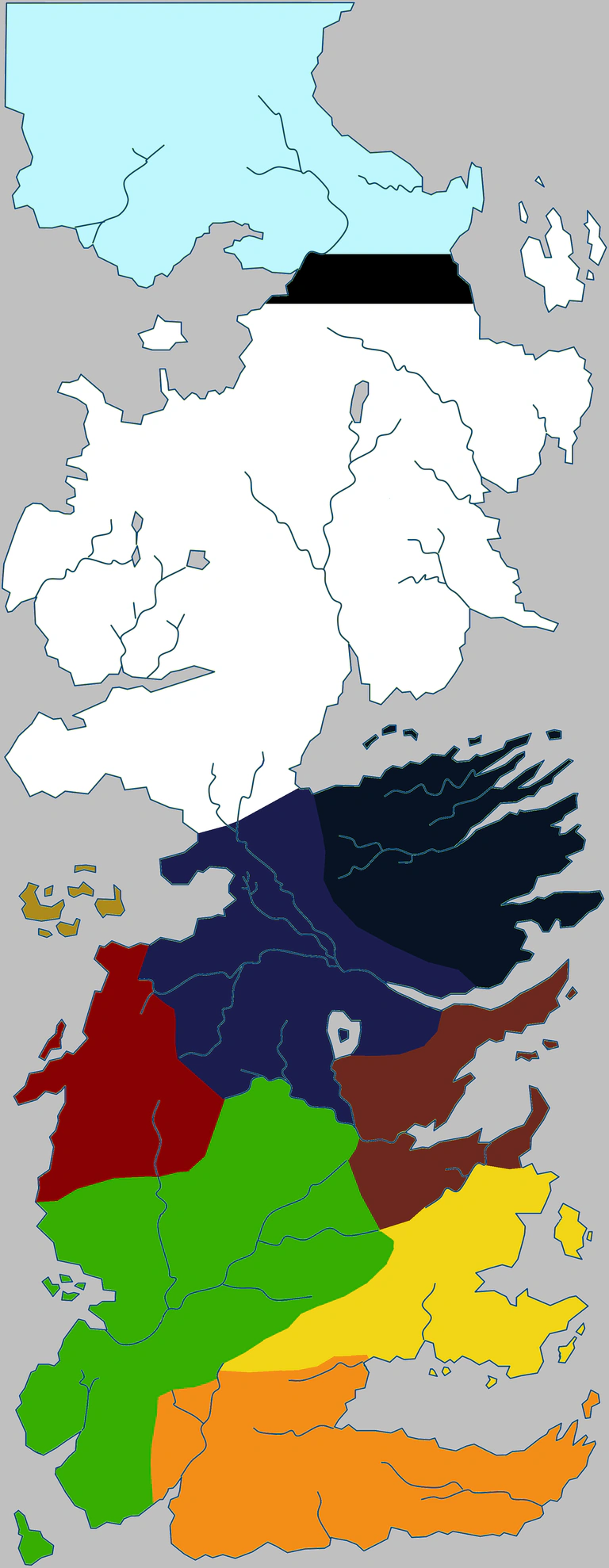
The Common Tongue is surprisingly uniform in the Seven Kingdoms - no doubt aided by three centuries of unification under the Targaryen kings - and there are no major separate dialects. From Last Hearth in the North to Salt Shore in Dorne, from the royal court at King's Landing to common Ironborn fishermen at Pyke, everyone speaks the same language with little difference in meaning. There are some regional accents, but nothing that would interfere with comprehension.
Dorne is ethnically distinct from the rest of the Seven Kingdoms, due to the Rhoynar migration, and it was also politically independent for many generations. It is also geographically very isolated, located in the extreme south of the continent and separate from the rest of it by mountains and harsh deserts. After the Rhoynar migration their descendants did learn to speak the Common Tongue, but with a pronounced Rhoynish accent - a local distinction which was reinforced due to centuries of geographical, cultural, and political isolation. Dorne was the only region to successfully resist invasion by the Targaryens, using guerrilla warfare, and only united with the realm one century ago through peaceful marriage-alliance. Due to their unique origins and isolation, modern Dornishmen speak with a very distinctive accent, differing from "standard" Common Tongue pronunciation even more than the "First Men accent" used by the Northmen and wildlings. Accents are all relative, of course, and Dornishmen such as Oberyn Martell have remarked that the "accent" that everyone in the rest of Westeros speaks with sounds strange to them.
In the TV series, both the Northerners such as the Starks and the wildlings living beyond the Wall speak with a Northern England accent. Even actors who do not naturally speak with a Northern England accent adopt one when playing characters from these regions, i.e. Rose Leslie who plays Ygritte. One of the reasons Leslie was actually cast as Ygritte is because she had previously given a strong performance on Downton Abbey while affecting a convincing Northern English accent.
Author George R.R. Martin has stated that Westeros is loosely inspired by Britain, super-sized into an entire continent roughly the size of South America. Both Northern England and Winterfell are located in northern regions and near a large, ancient fortification (Hadrian's Wall) separating them from the lands beyond, so a Northern accent fits the Starks. Also, within the fictional universe, both the Northerners and the wildlings are descended from the First Men (loosely analogous to the Celts), so logically, their notable accent may be a result of lingering influence of the Old Tongue.
The Dornish accent used in the TV series is based on a Hispanic accent, because Dorne is heavily inspired by medieval Spain. The novels state that the Dornish have a very distinctive accent, known as a "Dornish drawl", but the TV series had to develop what exactly it sounded like. For how it was developed for the TV series, see "Behind the scenes: Regional and class accents" below.
Class accents
While the Common Tongue is geographically quite uniform, the biggest internal distinction is between the upper and lower classes. Noble-borns, as well as other upper class people such as wealthy merchants, tend to speak a more refined and "proper" form of the language, because they can afford a better education. Learned people such as the clergy of the Faith of the Seven or the Order of Maesters also speak with a refined accent which is close to the idealized "official" version of the Common Tongue.
In contrast, commoners cannot afford an education, and tend to slur their language as a result. A specific difference pointed out by Tywin Lannister to Arya Stark is that commoners say "m'lord" almost as one word, while educated noble-born people will typically say "my lord" as two distinct words. Lowborn speech also often features grammar errors that "proper" speech avoids. For example, Davos Seaworth (a former lowborn smuggler) jokes to Lord Stannis Baratheon that he doesn't mind so much that he had the four fingertips on his right hand cut off as punishment for his former smuggling career, because he now has "four less fingernails to clean". Stannis then points out that the correct grammar is "four fewer fingernails". On the eve of the Battle of the Blackwater, Tyrion Lannister comments to Bronn that just because he pays Bronn for his services doesn't diminish their friendship, to which Bronn responds, "enhances it, really". Tyrion is surprised that Bronn used the word "enhances", as it sounds like the vocabulary of an upper-class person, but is a "fancy" word for a common sellsword to use. Bronn explains, "[I've] been spending time with fancy folks".
In the books
The Common Tongue is virtually the only language spoken throughout the entire continent of Westeros. It is stated that about half of the wildlings can only speak the Old Tongue, generally those that live farther away from the Wall or isolated in the mountains. As for the other half of the wildlings, it isn't clear what proportion are bilingual, or perhaps only know the Common Tongue. For that matter, it isn't clear for what proportion the Common Tongue is their primary or secondary language. Nonetheless, the Night's Watch usually doesn't encounter a language barrier with the wildlings that they encounter in their rangings, still relatively close to the Wall.
Sources
Adapted from the original article, under CC BY-SA 3.0.