
Lore
Old Tongue
Ancient language spoken in Westeros by the First Men
The Old Tongue is the ancient language spoken in Westeros by the First Men. The Old Tongue, as well as its runic script, was gradually supplanted by the language and alphabet of the Andals, now known as the "Common Tongue" of Westeros.
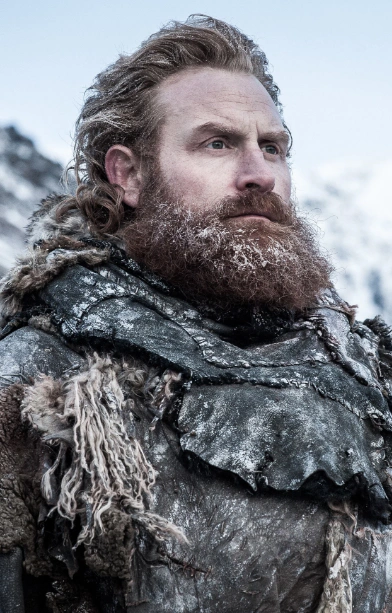
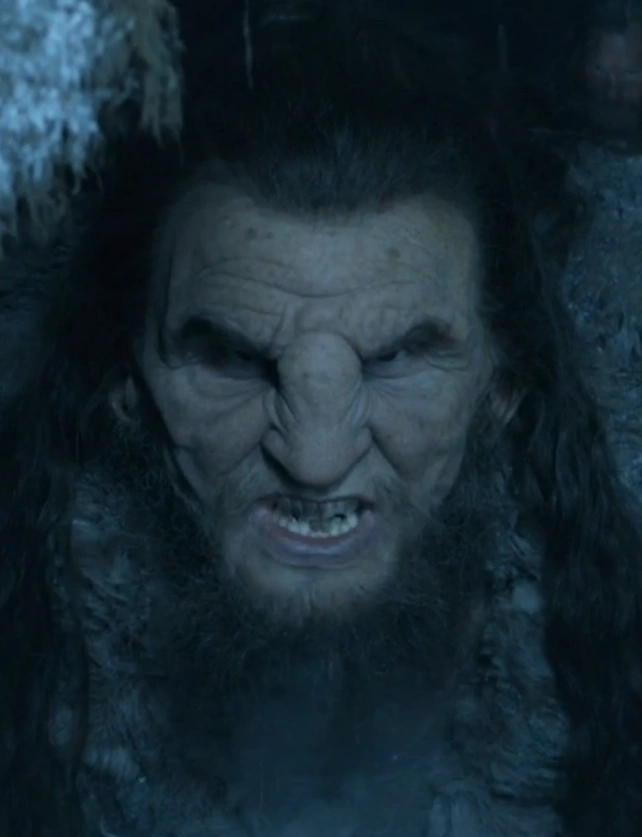
In the present day, however, the Old Tongue is still used by some of the wildlings in the far reaches of the lands beyond the Wall. The Thenn people, for example, still speak the Old Tongue. The non-human race of Giants live in the farthest northern reaches of the lands beyond the Wall and therefore had no contact with Andal peoples to the south, thus the giants speak only a rudimentary version of the Old Tongue known as "Mag Nuk", the Great Tongue. However, Tormund believes that they've picked up a better understanding of words and phrases from the Common Tongue than they let on.
Dialects
The lands beyond the Wall are quite rugged, with little in terms of long-distance trade or travel, and this geographic isolation resulted in the wildlings diverging into about six major subgroups, each of which speaks its own sub-dialect of the Old Tongue. Mance Rayder remarked to Jon Snow that the wildlings in his army spoke seven "languages" (apparently six dialects of Old Tongue, plus those who can speak the Common Tongue of the Andals).
Of these six dialects, only the dialect spoken by the giants has appeared in the TV series, a very brief sample in Season 5.
Mag Nuk
Mag Nuk (meaning "The Great Tongue") is the dialect of the Old Tongue used by the non-human race of giants. Because giants simply do not have the mental capacity of an ordinary human being, they actually speak an extremely simplified pidgin of Old Tongue. Essentially all linguistic rules of syntax and morphology have been dropped. Apparently in ancient times the giants learned what they could of the Old Tongue spoken by the First Men and eventually abandoned whatever previous language they used. Most linguistic features or rules that the original Old Tongue had - noun declension, pluralization, verb tense, etc. - were dropped entirely (and it isn't even clear if the original Old Tongue had these features to begin with).
Another drastic simplification is that all polysyllable words from the original Old Tongue were shortened to a single syllable. For example, while "skagos" means "rock" in regular Old Tongue, the word for "rock" in Mag Nuk was shortened to simply "skag". This seems to match giant naming conventions, also limited to monosyllable words: the giant leader nicknamed "Mag the Mighty" is properly named "Mag Mar Tun Doh Weg". Even the phonology of the original Old Tongue was simplified in Mag Nuk. Vowels are o [ɔ]; a [æ] (unless it’s before r, in which case it is [ɑ]); i [ɪ]; u [ǝ]. Then for the few consonants that might be confused, kh [x]; r [ɹ]; th [θ].
Even Mag Nuk itself is not used very consistently by the giants, and use can be quite sloppy from one individual to the next.
The only extant example, spoken by Wun Weg Wun Dar Wun in Season 5's "Hardhome", is:
This was also shortened down to:
The corresponding regular Old Tongue phrase would be something loosely along the lines of:
Mag Nuk Lexicon:
Lokh doys bar thol kif rukh?
Who/what fuck/shit you sit look it/him? = "What the fuck you looking at?"
Lokh kif rukh?
Literally, "What look it/him?"
Lokh doysen bar thol kifos rukh?
bar - you
doys - fuck!/shit! (general curse word, meaning is variable)
kif - look
lokh - Who/What? (general question word)
mag - great
nuk - tongue/language
rukh - it/him
skag - rock
thol - sit
In the novels, it is said the giants call the Children of the Forest "woh dak nag gram", which means "little squirrel people".
Writing system
The First Men had no letters, but the runes they would scratch onto rocks.
The Old Tongue has a simple, rune-based writing system, but it was never used for anything more advanced than marking graves. Thus the earliest written histories in Westeros only date back to six thousand years ago when the coming of the Andals introduced the full alphabet writing system of the Andal language (the Common Tongue). The First Men didn't use their rune system to write historical narratives, therefore everything before the coming of the Andals relies on oral tradition.

The runes used on-screen (for the sigil of House Royce) appear to not have been invented from scratch, but based on real-life Anglo-Saxon Futhorc runes.
The sigil of House Royce contains four strings of runes, one around each side. They don't inherently need to form a complete sentence and in-universe might just be a series of abbreviations, etc. Nonetheless, using real-life transliterations of the Anglo-Saxon Futhorc alphabet, the runes in the sigil actually do seem to convey meaning, instead of just being a random string of characters:
The top line (the only one easily readable without tilting your head) transliterates as "RUNS" - perhaps a contraction of "RUNeStone", the castle-seat of House Royce.
The next three lines, proceeding clockwise, actually do seem to form a coherent sentence:
Written out longways, including the punctuation breaks, it spells out "Run before your blood" - which certainly seems to be a coherent message instead of just random characters. The full meaning is apparently along the lines of "Run (from our war banner) before (we spill) your blood".
Alternate = RUN, BEFORE YOUR BLOOD RUNS (Comma represented by Double Dot " : " and Space by Single " . ") More easily seen on Banner which reads top down.
RUN:BEFO
RE:YOUR
BLOOD
In the books
At the time of the War of the Five Kings, it is said that roughly half of the wildlings only know the Old Tongue, and can't speak the Common Tongue. As for the other half that do know the Common Tongue, it isn't clear what proportion of them are bilingual in each language, or which of the two is their primary language.
Generally, knowledge of the Common Tongue is greatest among the wildlings in the south closest to the Wall, as knowledge of it filters up from the south through trade contact (or raiding). Thus the Night's Watch usually doesn't face a language barrier with the wildlings its members encounter near the Wall. In contrast, the Old Tongue tends to be more dominant in more isolated areas further away from the Wall.
The Giants only speak the Old Tongue, given that they live in the farthest north of the lands beyond the Wall and haven't come into contact with peoples of the south for generations. Giants aren't quite as smart as the average human, and Tormund (who knows the Old Tongue) says that the version of it they speak is a bit simplified. Giants do have the intellectual capacity to learn the Common Tongue, they simply haven't had the time or exposure to pick up more of it. After Mance Rayder's army is defeated in the battle for the Wall, a giant who surrenders (Wun Wun) starts learning some basic Common Tongue easily enough.
Sources
Adapted from the original article, under CC BY-SA 3.0.