
Lore
Dothraki (language)
Dothraki is the language spoken by the Dothraki people, the nomadic mounted…
There is no word for "thank you" in Dothraki.
Dothraki is the language spoken by the Dothraki people, the nomadic mounted tribes of the central plains of Essos, known as the Dothraki Sea.
The Dothraki do not have their own writing system, nor much use for the writing systems of neighboring peoples, so they are an illiterate society.
Important terminology
athjahakar - "pride, prowess". Derived from "jahak," the traditional long braid worn by Dothraki warriors ("warriors" being "lajaki").
Dosh Khaleen - council of crones. Widows of deceased khals, who preside over the Dothraki city of Vaes Dothrak. Wise-women who are essentially the leaders of the Dothraki religion.
Dothraki - lit. "men who ride", "riders"; the Dothraki people. A single Dothraki rider is a dothrak.
The noun for "riders" plural is Dothraki. The verb for "ride" conjugates as Anha dothrak = "I ride," Me dothrae = "You ride," Kisha dothraki = "We ride." Thus "dothraki" can also be the first person plural conjugation for "(We) ride" - it's just a homonym.
Dothrakhqoyi - "Bloodrider", a Dothraki warrior that has pledged his life to the service of a khal.
Frakhas valad! - riding command to a horse, literally "touch the horizon", more closely meaning "ride to the horizon!", and euphemistically just a variant of "ride!" or "giddyup!", etc. Because riding commands tend to be shortened down from full sentences, riders often just exclaim "valad!" (literally, "horizon!") to say "giddyup!", but this is clipped from the full phrase.
Khal - Dothraki warlord.
Khaleesi - the wife of the khal.
Khalasar - Dothraki clan or tribe, led by a khal.
Ko - Kos are lieutenants of a khal, commanding subdivisions of a khalasar. On the death of a khal, a ko may try to become the new khal, or split off his own riders to form a new, smaller khalasar.
Me nem nesa - "it is known"
Qoy Qoyi - (literally, "blood of my blood") the style of address between Khal and bloodrider.
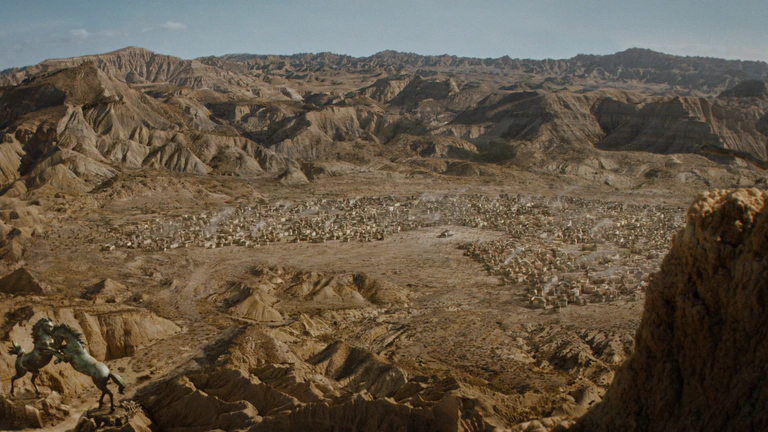
Vaes Dothrak - the only Dothraki city, located deep within the Dothraki Sea.
zhey - the Vocative particle in the Dothraki language, used when directly addressing the object of a sentence; thus it is very frequently heard in Dothraki dialogue. While the Vocative case was present in the Proto-Indo-European language, it fell out of use in modern Romance languages, as well as Germanic languages such as English and German (but is still present in Celtic and Slavic languages). Thus there is no direct English equivalent for zhey, though it basically means "you", or more loosely, "hey", and often isn't directly translated as its own word in a sentence. For example, Rakharo says to Irri, "Hash yer ray tih loy alegra, zhey vikeesi?" (Have you seen any ducks, woman?). However, Daenerys says "Zhey qoy qoyi!" (Blood of my blood!) when addressing her bloodriders, or simply "zhey Rakharo" (literally just "Rakharo"), when trying to get Rakharo's attention. However, the Vocative particle may also be used reflexively when the subject is referring to himself: Khal Drogo swears "Anha, zhey Drogo, atak jin" (I, Drogo, will do this).
"Athjahakar"
According to an interview with David J. Peterson on Forbes.com in November 2012, there is actually only one line in the Dothraki language in Season 3 of the TV series. This brief line occurred when Daenerys and Missandei are discussing the Dothraki language in "Second Sons":
Zhey Drogo ast me-Dothraki thasho h’anhaan ven anha ray yol mehas. Me azh maan atjakhar.
"Athjahakar" was intentionally slurred as "atjakhar" so Missandei could correct Daenerys's mistake.
"Drogo said I spoke Dothraki like one born to it. It gave him great pride."
In the books
Arguably, given the sheer size of the Dothraki Sea, the Dothraki language approaches the Common Tongue of Westeros and the Low Valyrian languages spoken throughout the Free Cities and Slaver's Bay in terms of overall geographical spread. However, the actual population density of the Dothraki Sea is very small, as Dothraki khalasars ride through massive grassy plains which are otherwise devoid of permanent habitation. If plotted on a map, this makes the Dothraki language look disproportionately common.
The population of the only Dothraki city, Vaes Dothrak, varies from time to time: there are rarely more than a few khalasars stopping in the city at any one time, before leaving again to find plunder. As a result, the permanent population of the city isn't much compared to one of the Free Cities or to a Westerosi city such as King's Landing. However, Vaes Dothrak is physically large enough to hold every khalasar if they return all at once (for special religious ceremonies, etc.). Daenerys estimates that it physically has ten times as many buildings as Pentos does, and Pentos is one of the more populous Free Cities (the most populous, however, is Volantis). This might give a general idea of the size of the overall Dothraki population.
On the other hand, the Dothraki do not engage in long-distance trade, which has severely hampered the geographical spread of their language. Some of their neighbors have learned Dothraki in order to treat with them (i.e. in the TV series, Illyrio Mopatis of Pentos is seen speaking Dothraki to Khal Drogo), but their language has not spread with trade along sea lanes. In contrast, the Common Tongue of Westeros has spread along with merchant ships so that many traders in the Free Cities and Slaver's Bay have some knowledge of it to conduct business in. Even the inhabitants of distant Qarth conduct sea trade with Westeros, and thus some knowledge of the Common Tongue may be found there. Similarly, Valyrian-speakers from the Free Cities may be found in the five major port cities of Westeros.
Sources
Adapted from the original article, under CC BY-SA 3.0.